Introducing pos-module-mcp: the governed agent runtime for platformOS
There is a question every platform team is quietly avoiding right now.
Not “should we support AI agents?”, since that one’s settled. The question is the one that comes immediately after, the one nobody wants to answer on the record:
When an agent gets it wrong, what happens next?
Because agents will get it wrong. Not maliciously, usually. A hallucinated product ID. A misread instruction. A poisoned tool description buried in metadata the user never sees. A perfectly reasonable plan executed against perfectly wrong assumptions. And in most architectures shipping today, the honest answer to “what happens next” is: nobody knows, and there’s no way to find out.
That’s the gap pos-module-mcp closes.
The uncomfortable state of the MCP ecosystem
The Model Context Protocol won. It’s the default integration layer, supported across every major AI client. Adoption has been extraordinary.
Governance has not kept pace. Independent security research through 2025 and 2026 painted a consistent and unflattering picture of publicly available MCP servers: a substantial majority carrying exploitable flaws (path traversal, command injection, SSRF) a small single-digit percentage implementing OAuth, and the overwhelming majority running as local processes on developer machines rather than governed production infrastructure. Over thirty CVEs landed against MCP servers, clients and infrastructure in a two-month window. The highest-severity finding scored 9.6.
Security teams analysing the major 2025–26 incidents converged on a single architectural root cause, and it’s worth stating precisely, because it explains everything:
There was no control operating at the semantic layer between the agent’s intent and the system action: nothing evaluating whether what the agent was about to do matched what it was actually authorized to do.
Every perimeter control in those environments observed the attack and recorded no violation. They weren’t designed to see what the agent was being instructed to do.
The protocol defines what is possible. It does not define what is safe.
We didn’t add AI to platformOS. We noticed platformOS was already built for this.
Here’s what happened internally when we mapped the MCP threat landscape against our own architecture. We expected a gap analysis. We got something closer to a coincidence.
What MCP servers are missing | What platformOS has shipped for years |
Per-action authorization; agents run on standing credentials | Named authorization policies, evaluated per call against a resolved identity |
No undo: failed agent plans leave partial state | Transaction and rollback tags, atomic by construction |
Free-form, unvalidated tool input | Typed GraphQL schema + declared input contracts |
Ad-hoc or absent audit trails | Records, with policy-enforced immutability |
No throttle: one agent can exhaust the system | Per-instance resource limits and rate accounting |
One shared process, one shared credential | Per-instance tenancy and scoped tokens |
Read that table again, because it’s the entire product thesis.
The properties the agent era demands (authorized, validated, reversible, attested, bounded) are not features we raced to bolt on when MCP got hot. They are the primitives platformOS was architected around, years before the protocol existed. Every other platform in this market is now hand-rolling authorization, rollback, and audit from scratch, under deadline pressure, in a threat environment that punishes exactly that.
Our governance predates the protocol. That is not a marketing line. It’s a build-order advantage nobody can retroactively acquire.
What pos-module-mcp actually is
It’s a host, not a hack. Install it, and your platformOS instance becomes an MCP server — but a governed one, where every single agent call passes through a control plane you didn’t have to build.
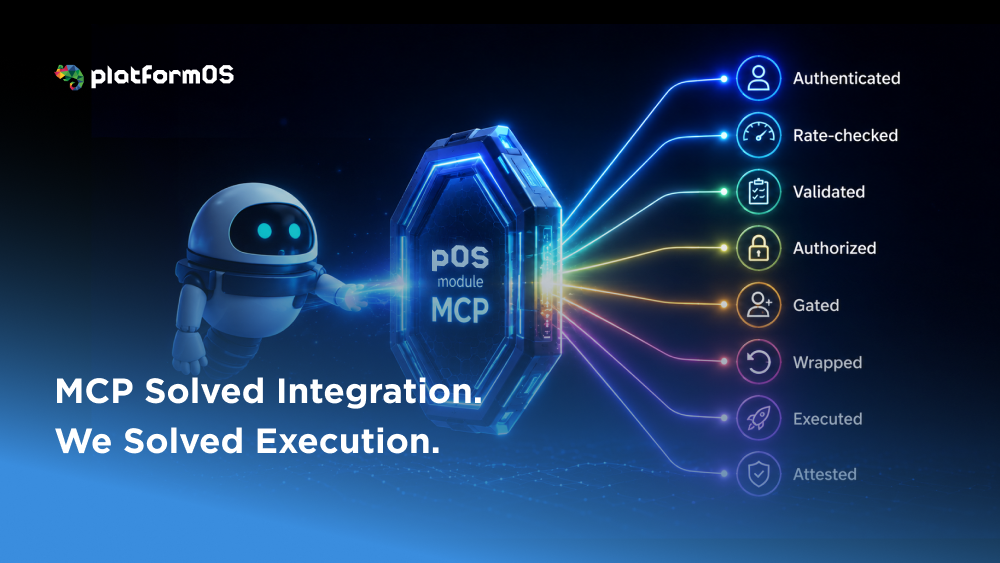
Here’s the entire lifecycle of an agent action:
Agent calls a tool
│
├─ Authenticated → a real identity, never a standing credential
├─ Rate-checked → per-principal limits; abuse auto-suspends the token
├─ Validated → against a typed schema you declared
├─ Authorized → by a named policy, evaluated per call
├─ Gated → high-impact actions wait for a human decision
├─ Wrapped → in a transaction that can roll back atomically
├─ Executed → your business logic, your commands
└─ Attested → written to a tamper-evident, hash-chained ledger
Every plane is on from the first call. Zero lines of governance code written by you.
Reads work on day one
Because platformOS pages already expose clean Markdown at /:slug.md, a format we shipped explicitly for agent consumption, your documentation and catalogue become MCP resources the moment you install the module. Governed, rate-limited, freshness-stamped. No authoring required.
No scraping rendered HTML. No brittle DOM parsing. No agent guessing at your structure.
Writes require intent, and declaring them is one command
There is no universal “update a listing” tool, and we refuse to pretend otherwise. Actions are business-specific by definition, so you declare them: a short manifest naming the input schema, the authorization policy, and whether the action needs human approval.
And declaring one is not a research project. A generator scaffolds the whole tool for you (manifest, handler, and typed GraphQL) correctly wired on the first pass. Better still, point the generator at an existing platformOS command and it reads that command’s real field usage, infers the schema, and emits a matching manifest. You wrap the business logic you already have as a governed MCP tool, in a single command, without hand-writing a schema.
The safe path is the easy path. That is deliberate: governance that’s tedious to adopt is governance that gets skipped.
That manifest lives in version control. It gets reviewed like code. Which means, and this is the part that matters more than it sounds, every tool description an AI model ever reads on your platform passed a human code review.
Tool poisoning, the attack where hostile instructions hide inside tool metadata the user can’t see, is the defining vulnerability of the agentic era. Our mitigation isn’t a scanner playing catch-up. It’s a structural property: there is no path by which unreviewed text reaches the model.
Where we pull decisively ahead
1. Reversibility is the permission slip
Ask any marketplace operator why their AI integration is read-only, and you’ll get the same answer in different words: because I can’t un-ring the bell.
Every mutating tool on platformOS runs inside a transaction. Handler fails, guardrail rejects, timeout fires, ledger write errors: the whole thing rolls back atomically. No partial state. No orphaned records. No 2 a.m. archaeology.
This is the property that converts “our agents can read things” into “our agents can do things.” It’s not a security checkbox. It’s the unlock for the entire write economy, and it’s the reason a risk-averse operator will say yes.
Honest boundary: transactions govern your data. They cannot recall an email, reverse a payment capture, or undo a third-party API call. The module handles this by requiring irreversible external effects to run post-commit or behind a human approval gate. We’d rather tell you that up front than have you discover it in production.
2. The audit trail is a guarantee, not a habit
Most systems log actions. We do something categorically different: the ledger entry commits inside the same transaction as the business mutation.
Content and its attestation live or die together. There is no code path, none, by which an agent action exists in your data without a corresponding record of who authorized it, what identity requested it, and what happened.
Then we chain it. Each entry hashes its own payload plus its predecessor, and an authorization policy denies update and delete to everyone, including admins. That turns “we have logs” into “we have logs that probably weren’t edited,” and a built-in chain verifier will tell you instantly, if a single entry was ever altered, reordered, or backdated. The append path is serialized, so the chain stays intact even under bursts of concurrent agent traffic.
And we log the denials. A ledger that records only successes is useless during an incident. The interesting question is never what worked, it’s what was refused, by whom, how many times, and starting when. The wire response to a denied call stays deliberately generic; the specifics go to the ledger, not to the caller probing for a way in.
3. Human judgment, exactly where it belongs
Some actions should never run autonomously, and which ones is your call, declared per tool. Mark an action as requiring approval and it never executes inline. It records the intent, returns an opaque handle, and waits.
An operator approves it in the console, and it then executes as the original principal, re-validated and re-authorized, with the resulting ledger entry linked back to the request. Reject it and nothing runs. Let it expire and nothing runs. A near-identical duplicate collapses into the existing request instead of stacking, and a per-principal cap keeps a runaway agent from flooding the queue.
This is what lets an operator hand an agent genuinely consequential capability without handing it the keys.
4. An agent can’t overrun what it can’t overrun
Governance that only checks whether an action is allowed, but never how often, isn’t governance: it’s an invitation to a denial-of-service.
Every principal gets a per-window rate limit. Cross it, or accumulate enough refused and malformed calls in a short window, and the token auto-suspends: a misbehaving or compromised agent takes itself offline instead of grinding your instance down. Oversized request bodies and pathologically nested inputs are rejected before they reach a handler.
The abuse counter is content-aware: rate-limit hits, schema rejections, and authorization denials all count toward suspension. A confused agent in a retry loop and a hostile one probing your surface look the same to the counter, and both get stopped.
5. Least exposure, by default
Delegation done properly: we support on-behalf-of as a first-class mode. The token carries the agent’s identity and the human principal it acts for; your policies evaluate against the human, and the ledger records both. A buyer’s agent inherits the buyer’s scope. It never holds its own.
And that scope is tight by construction. A token can be narrowed to a specific subset of tools, so a compromised credential can only reach what it was minted for. Any token can be revoked centrally in one move: a leaked bearer is cut off by flipping its status, instantly, everywhere. Tool discovery itself is scoped: tools/list can be filtered to only the tools the caller is actually authorized to invoke, so an unauthorized or anonymous agent doesn’t even learn that your privileged surface exists.
That distinction is invisible on a feature chart and decisive in a security review.
6. One module. Every instance. Same posture.
Install it across your entire estate and every instance gets identical governance: scoped to its own data, its own tokens, its own resource identifier, its own ledger. No per-partner engineering. No configuration drift. No instance quietly runs weaker controls than its neighbour.
For channel partners running multi-tenant stacks, this is the difference between “we secured the agent integration” and “agent integration is secure by default, everywhere, forever.”
7. Your compliance artifact builds itself, and you can watch it live
Here’s the part your legal team will appreciate more than your engineers do.
The regulatory direction of travel is unambiguous: logging, data governance, human oversight, and demonstrable control over automated action. When an agent takes a consequential action through an MCP server, that action falls inside those obligations.
Every organisation deploying agents will eventually need to produce evidence of exactly that. Most will assemble it retroactively, in a panic, from logs that were never designed for the purpose.
Yours is already written. Chained, immutable, queryable via GraphQL, exportable on demand, generated as a byproduct of running the system correctly, not as a separate compliance project.
And you don’t have to query it blind. The module ships a built-in operator console: a single, dependency-free screen showing live call metrics, one-glance chain verification, the approval queue, the abuse watchlist, active tokens with a one-click kill-switch, access requests, and a ledger export. When something does go wrong, the console doesn’t just alarm, but it points you at the exact entries involved. Incident response is a page, not a project.
8. We don’t just govern your tools. We prove it, by attacking them.
Anyone can claim their controls hold. We hand you the means to check.
Because every governed call is already attested in the ledger, we provide an agentic security evaluation harness alongside the module: a real LLM agent is pointed at your governed tools as a low-privilege principal and told to break in, escalate privilege, inject through arguments, reach another tenant’s data, flood the queue. It’s graded not on what the agent claims, but on what the ledger records actually happened. A blocked attack is a proof point; a successful one is a finding you see before your customers do.
And we validate the validator: the harness is exercised against deliberately-vulnerable control tools, confirming it detects a real breach rather than rubber-stamping a pass. You get an adversary with an incorruptible referee, run against your declared tools, and not a generic checklist.
How this compares
| Bespoke MCP server | Generic MCP gateway | pos-module-mcp |
Authorization | You build it | Coarse, at the perimeter | Named policies, per call, per identity |
Rollback on failure | You build it | Not addressed | Transactional by default |
Input validation | You build it | Schema pass-through | Typed, enforced, unknown keys rejected |
Rate / abuse limiting | You build it | Sometimes, coarse | Per-principal, with auto-suspend |
Human approval gate | You build it | Rare | Declared per tool, executes as principal |
Audit trail | You build it | Gateway-level logs | Chained, immutable, transaction-bound |
Tamper detection | Rare | No | Built-in chain verifier |
Tool poisoning defence | Hope | Scanning | Structural: review-gated by design |
Delegated identity | Rare | Sometimes | First-class on-behalf-of |
Discovery scoping | No | No | tools/list filtered by authorization |
Authoring effort | High | N/A | One generator command; wraps existing logic |
Adversarial self-test | No | No | Agentic eval graded on the ledger |
Multi-tenancy | You build it | Per deployment | Native |
Knows your business logic | Yes | No | Yes |
That last row is the one that decides it.
A gateway sits outside your application and can only reason about traffic: it doesn’t know that repricing a listing has a category band, or that an order past shipping can’t be cancelled. A bespoke server knows your logic but starts its security posture at zero and stays there under deadline pressure.
We’re the only option that knows both: because the governance and the business logic live in the same runtime.
The one-sentence version
Hand this to your CTO:
platformOS is where agents can act, because every action is authorized, bounded, reversible, and attested, and provable.
Not “we support MCP.” Everyone will support MCP by Christmas. Supporting a protocol is a compatibility statement. Governing what moves through it is an architecture.
Where we are, honestly
We’re building this in phases, and we’re going to tell you which is which: because a governance product that overstates its own maturity has already failed at the thing it’s selling.
Phase 1: governed reads. Shipped. Tool listing and invocation for non-mutating tools, resources over Markdown pages, full identity binding, validation, authorization, rate/abuse limiting and the hash-chained ledger from the very first call. The load-bearing planes, proven.
Phase 2: governed writes. Shipped. Transaction-wrapped mutation, the human-approval workflow, and idempotency for agent retries are delivered and exercised by a real adversarial test suite. Writes are governed today, not on a slide.
Phase 3: surface completeness. In progress. Prompts and richer protocol coverage are landing; resource templates and dynamic discovery at scale are next.
On the roadmap. Streaming and long-running async handles, and agent-assisted tool authoring, building on the generator so that describing a new governed tool becomes a conversation, not a checklist. The safe path is already the easy path; we intend to make it the default path.
We deliberately shipped the boring, load-bearing parts first. Identity and attestation are the hard problems; mutation is comparatively easy once they’re right. Any vendor doing it in the other order is showing you a demo, not a foundation.
The window is open, and it will close
The security literature has a phrase for where MCP sits right now: the brittle phase, where adoption has outpaced governance.
Brittle phases don’t last. Either the ecosystem matures, or a serious enough incident forces maturity overnight. Either way, the platforms that already had authorization, reversibility, and attestation as native primitives will be the ones agents are trusted to act on, and the ones still assembling those properties under deadline will spend that period explaining themselves.
We’re not scrambling to add governance to an AI feature.
We’re opening a door that was already locked properly.