Explore the series:
Start from what’s missing
The natural way to explain something you’ve built is to list what it does. This one is easier to explain by what it takes away.
pos-ai-bridge-mcp is an early prototype of a standalone platformOS module. Install it, and a live instance becomes a native MCP server. MCP being the standard through which AI agents discover a system’s operations and call them. An agent connects and works, for the session, as a platformOS developer and operator. The module ships with per-install scoped tokens, an audit log, a kill-switch, and its most powerful scope switched off by default.
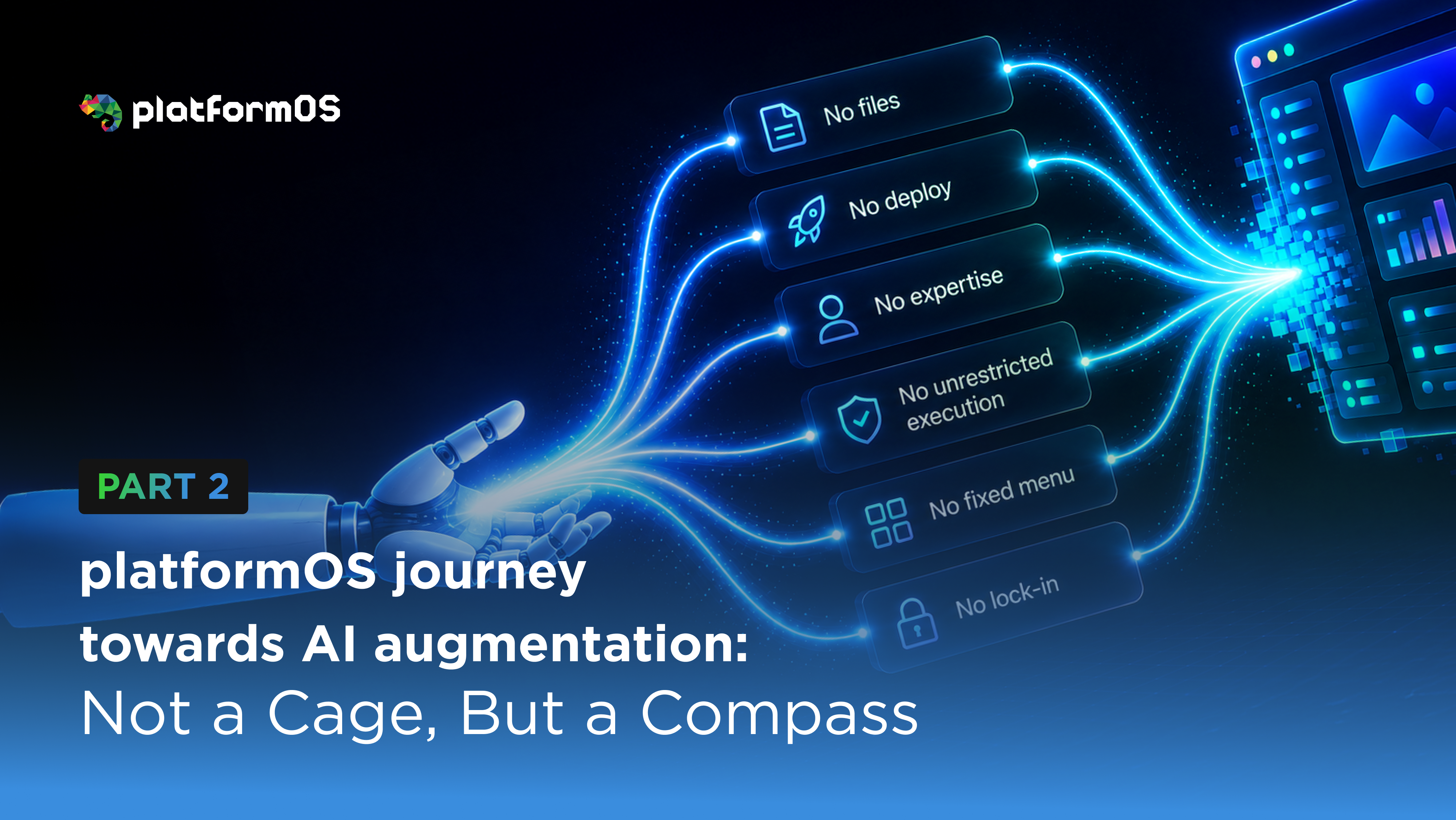
That’s the one-paragraph version. The truer version is a list of removals. Each thing we took away unlocked something we couldn’t have easily gotten by adding. Six subtractions, in the order they mattered.
1. We removed the files
The default way to let an LLM agent build software is to let it write code: files that then run, capable of anything, checkable only after the fact. We took that away. Through the bridge, the model never emits code that executes. It calls typed operations.
At the top of the surface sit the big ones. pos_scaffold_crud: a complete access-controlled feature: model, list and detail pages, create form, the queries behind them, and in one call. pos_apply_spec: describe the end state, and the instance converges to it. pos_examples: tested recipes for common app shapes. Underneath, single bricks: create a page, a model, a query, a partial, a layout. And around everything, the operational tools that make this a system rather than a generator. pos_check_page renders a page and returns the real error inline. pos_audit reviews the build for the patterns that should worry you. pos_snapshot, pos_restore, pos_undo. pos_batch with atomic: true, where a failure anywhere reverses everything already applied.
Removing files removed a whole category of failure: “the AI wrote something subtly wrong and nobody noticed until production.” What’s left to go wrong is a bad composition. And compositions are checkable.
2. We removed the deploy
Every operation takes effect on the live instance the moment the call returns, reachable at a real URL. No build step. No latency between decision and consequence.
This is possible because of the one property everything rests on. Most platforms separate build time (compilers, pipelines, privileged machinery) from run time, the thing serving requests, which is forbidden from restructuring itself. platformOS doesn’t. A running page can authenticate to the platform’s own administrative GraphQL API and, mid-request, create pages, models, queries, records. The bridge is built entirely on that. Its MCP endpoint is a single .json.liquid page. Its logic is Liquid partials. Its provisioning is a self-call to the admin API. A tool call is a page request; the thing it describes exists before the response finishes serializing.
Removing the deploy turned feedback from a report into a steering wheel. Every check runs against the actual consequence of the last action: the rendered page, the record diff, the access rules under a real signed-in session. For a fallible model, that loop is the difference between drifting and correcting.
3. We removed the expertise requirement
platformOS rewards people who know its idioms and punishes those who don’t, and often silently. parse_json throws instead of returning nil. A parameter named slug gets quietly eaten by the router. The string “false” written to a boolean field stores true.
The bridge carries that knowledge so its callers don’t have to. The idioms are encoded in the tools. The sharp edges live in a machine-readable quirks manifest the agent must read before hand-writing anything. Generated code comes out already avoiding the traps. The practical effect: a person who has never seen a line of Liquid, or an agent trained mostly on other stacks, can stand up a real, multi-page, data-driven application without stepping on the mines we spent weeks mapping.
4. We removed the model’s ability to do “anything”
This is the security architecture, and it’s simpler than it has any right to be. Every mutation flows through one pure mapper that emits exactly one admin GraphQL operation and nothing else. Around it, firewalls: reserved tables refused, control routes protected, platform secrets unreadable from generated content, record writes filtered through a field allowlist.
Here’s the striking part: those firewalls are mostly static checks. String scans, not sandboxes. That works because platformOS content isn’t arbitrary code. It’s Liquid plus stored, named GraphQL queries: no inline query form, no eval, no shelling out. A finite grammar of side effects means a validator can know what a page will do by reading it. The audit tool exploits this directly: every query a page runs is somewhere nameable, never smuggled inline.
The principle underneath is the most transferable thing in the project: the model proposes, deterministic code disposes. Nobody trusts the model. Everybody can read the proposal.
5. We removed the fixed menu
The platform extends through modules, and a module can now contribute its own MCP tools. Drop a small registration file into any third-party module and the bridge’s endpoint discovers it and routes calls to it. The agent’s capabilities aren’t a list we curate. They grow through the same mechanism the platform itself grows through. “Extend the platform” and “extend what an agent can do on it” became one act.
6. We removed the lock-in
A bridge-built app isn’t captive. At any point, /mcp-eject downloads it as a clean, standalone platformOS source: pages, models, queries, partials, assets, zero bridge artifacts, dependencies only on the platform’s canonical modules. From there it’s an ordinary codebase: git, review, CI.
Honesty tax, paid on schedule: the eject exists, and proof that it round-trips losslessly (deploys unchanged on a bridge-free instance, diffs clean under the standard tooling) is still the top open task. We treat it as a task rather than a footnote precisely because so much depends on it.
What the subtractions add up to
Strip six things away and what remains is a short list of unlocks, each real to achieve today.
Anyone can ship on platformOS. Not just “generate a landing page,” but stand up a working, verified, reasonably secure application without knowing the stack, at a speed that a file-based workflow can’t approach. A simple CRUD application can be done in a single pass. Something a bit more ambitious, given a good spec, is now only a few rounds away and takes just dozens of minutes to reach a working prototype.
The platform itself became agent-operable. Not “an AI writes code into a repo” an agent stands up, inspects, audits, and reverses running applications, with the platform enforcing invariants the agent can’t break even when confused.
Granularity became a choice. The same machinery that powers the full builder instantiates down to a server exposing three tools over one data model and nothing else. Any platformOS app can offer an agent-callable surface at any point between a single tool and the entire platform, and that lighter end is where the near-term, lower-risk value is concentrated. We deliberately test the heaviest and least secure scenarios to uncover risks. We make no claim that every risk has been eliminated, but uncertainty shrinks as the agent’s surface shrinks.
And prototypes got an exit. Build fast while the design is still a question. Eject and own the code when it stops being one. The file-based and pos-cli paths always remain open.
What Subtraction Revealed
We didn’t eliminate our limitations, nor was that ever the objective. Ironically, the very constraints that have historically been viewed as our weaknesses become strengths in this setting: they make the boundary explicit and enforceable. What matters is that the frontier has shifted and our experiments suggest that we have moved much farther than we expected. That is the real takeaway from this project, and it extends well beyond platformOS: the safe shape for AI-generated software is a constrained operation surface over a substrate whose execution model is itself analyzable. The LLM’s creativity is spent on composition rather than unconstrained code generation. platformOS did not evolve with AI agents in mind, yet many of the properties that once felt restrictive turn out to be precisely the ones that make this model practical.
Editorial note
One of the more interesting outcomes of the pos-bridge exploration was that it also became an evaluation of platformOS from an AI-first perspective. It highlighted an unexpected property: several characteristics that are traditionally perceived as limitations actually become advantages when the primary developer is an LLM rather than a human.
For human developers, a constrained framework can feel restrictive. In contrast, LLMs perform best when the solution space is well defined. Every additional abstraction layer, configuration option, or architectural pattern increases the number of valid implementations the model must reason about, which raises the probability of hallucinations, inconsistent code generation, and architectural drift.
platformOS naturally limits that search space. Its conventions, predefined application structure, opinionated resource model, and consistent programming model provide strong priors for an AI agent. Instead of solving an open-ended software engineering problem, the model is solving a constrained transformation problem within a known architecture.
This predictability also enables tooling that would be considerably harder to build for more heterogeneous stacks. Static analysis, dependency graph generation, impact analysis, project-wide validation, architectural guidance, and automated repair become significantly more reliable because the platform exposes a relatively consistent shape across applications. Rather than compensating for architectural diversity, AI tooling can invest more effort into understanding project semantics and enforcing correctness.
From that perspective, platformOS does not require a fundamental architectural shift to become AI-native. The underlying architecture already provides many of the invariants that agentic development benefits from. The missing layer is not a new runtime or programming model, but tooling that exposes those invariants to AI agents in a structured, machine-readable way.
Part 3 is the machinery meeting reality: what was actually built with it, what the year did around it, and where the vectors point.