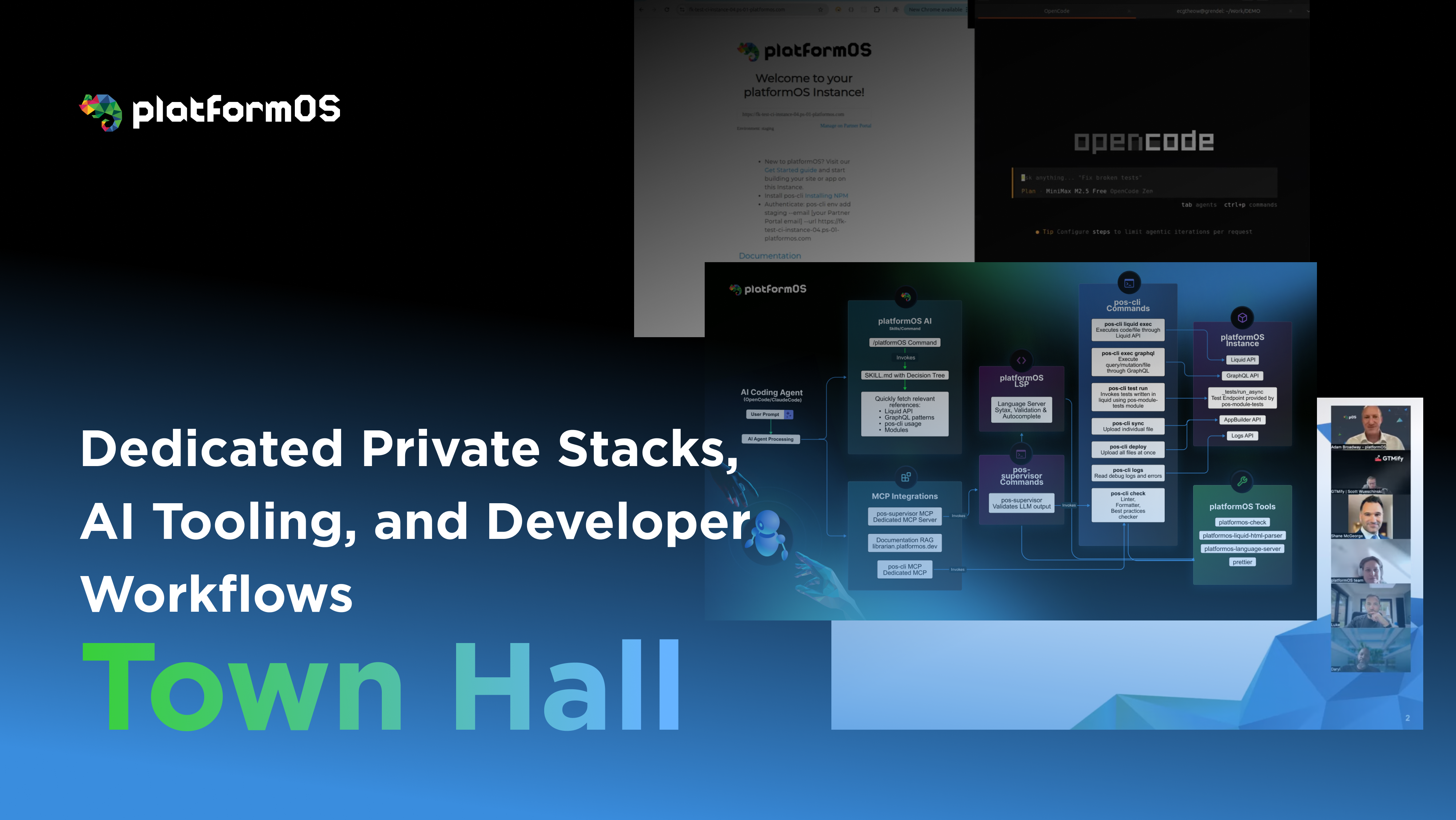
The latest platformOS Town Hall brought together partners, developers, and agencies for a deep dive into the platform’s evolving infrastructure strategy, AI tooling ecosystem, and dedicated private stack offering.
The session focused on a central theme: enabling businesses and agencies to retain control over their infrastructure, workflows, and data while leveraging AI to accelerate development—not replace developers.
Why Dedicated Private Stacks Matter
As AI adoption accelerates across industries, concerns around code ownership, data sovereignty, infrastructure dependency, and vendor lock-in are becoming increasingly important for agencies and enterprise clients alike.
platformOS is addressing this challenge with Dedicated Private Stacks (DPS): isolated, infrastructure-agnostic environments that allow businesses to:
Maintain full ownership of their data and workflows
Deploy on Oracle Cloud, AWS, or private infrastructure
Build AI-powered products within secure environments
Scale multi-tenant SaaS solutions with managed DevOps support
Create client-specific deployments when needed
The goal is to provide the flexibility of modern cloud infrastructure without forcing organizations into centralized ecosystems that control both the data and the AI layer built on top of it.
As Adam Broadway explained during the session:
“Businesses need the ability to build their own AI workflows and agents while retaining sovereignty over their data and infrastructure.”
This architecture also supports platformOS’ long-term focus on automation, scalability, and modular development.
Siteglide’s Migration Experience
A major part of the Town Hall featured insights from Luke Wakefield of Siteglide, who shared the company’s experience migrating from shared infrastructure to multiple dedicated private stacks.
According to Luke, the migration process was significantly smoother than expected, thanks to platformOS tooling and collaboration with the engineering team.
Key benefits included:
Simplified site migration workflows
Consolidated billing management
Improved DNS and deployment management
Cloudflare integration advantages
Greater pricing flexibility for enterprise clients
Infrastructure independence from a single cloud provider
One notable advantage is the ability to migrate individual high-growth customers onto their own dedicated stack as their requirements evolve.
This creates a scalable pathway from shared environments to enterprise-grade isolated infrastructure without requiring a complete platform migration.
AI-Augmented Development, Not “Vibe Coding”
A major focus of the Town Hall was platformOS’ approach to AI-assisted development.
Rather than promoting “AI replacing developers,” the team emphasized AI augmentation: enabling developers, designers, QA engineers, and agencies to work faster and more efficiently while keeping humans in control of architecture, review, testing, and business logic.
The platformOS team has spent the past year building internal tooling designed specifically to improve the reliability of AI-generated code inside platformOS environments.
These tools include:
Reusable module ecosystems
AI-aware CLI tooling
LLM supervision layers
Validation systems
Skills and MCP integrations
AI-powered testing workflows
Custom AI development teams and agents
Markdown-first documentation support
The philosophy is simple: AI should accelerate experienced developers, and not replace engineering discipline.
Introducing platformOS Supervisor
One of the most impressive demonstrations during the Town Hall showcased the new platformOS Supervisor.
Presented by Filip Kłosowski, the Supervisor acts as a real-time validation layer for AI agents generating platformOS applications.
The challenge with large language models is that they often generate code that looks correct but fails deployment or breaks platform-specific rules.
The Supervisor addresses this problem by:
Continuously validating generated code
Catching syntax and deployment errors immediately
Preventing “error cycling”
Providing actionable corrections in real time
Guiding AI agents before invalid files are finalized
The system integrates directly with:
pos-cli
platformOS Check
LSP tooling
MCP integrations
Validation pipelines
During the live demo, a landing page with a database-connected contact form was generated from scratch using a lightweight open-source model and the Supervisor tooling.
Importantly, the project began with an empty instance: no starter templates, no cloned project, and no predefined codebase.
The demonstration highlighted how platformOS is expanding its AI-assisted development workflows while preserving deployment reliability and validation standards.
Major platformOS Tooling Improvements
The Town Hall also introduced several significant tooling upgrades designed to improve both developer experience and AI-agent compatibility.
Faster Deployments with pos-cli deploy
The deployment pipeline has been optimized to improve both developer workflows and AI-agent feedback loops.
Updates include:
Faster deployment performance
Full validation reporting
Dry-run deployment checks
Clearer deployment summaries
Better handling of large projects
Instead of failing on the first issue encountered, deployments can now surface multiple validation errors simultaneously, reducing iteration cycles significantly.
Improved Liquid Syntax
platformOS also introduced several Liquid syntax improvements designed to simplify development and improve compatibility with AI-generated code.
New capabilities include:
These updates reduce verbosity and make templates easier to read, maintain, and generate programmatically.
Markdown Support for AI Workflows
Markdown support was another important topic during the session.
Because markdown contains significantly less structural overhead than HTML, it works particularly well for AI-assisted workflows and retrieval systems.
platformOS now supports .md rendering directly, allowing teams to:
Reduce token usage
Improve AI retrieval quality
Simplify documentation pipelines
Create cleaner AI-readable content structures
This is especially useful for documentation-heavy projects and internal AI tooling.
AI Bots Powered by platformOS
The Town Hall concluded with a demonstration of platformOS-powered AI bots running inside dedicated private stack environments.
Presented by Dariusz Gorzęba, the demo showcased assistants capable of:
Monitoring infrastructure metrics
Querying GraphQL endpoints
Analyzing lead submissions
Indexing documentation
Generating operational summaries
Automating scheduled tasks
Integrating with Slack and Discord
The bots are designed around isolated environments, controlled permissions, and secure integrations.
Several practical use cases were discussed, including:
Internal knowledge assistants
DevOps monitoring bots
AI-powered lead qualification
Customer support workflows
Operational reporting systems
The architecture also supports MCP integrations and custom workflows tailored to specific agency or enterprise requirements.
Looking Ahead
One of the clearest themes throughout the Town Hall was that AI is rapidly changing software development workflows, but infrastructure ownership, developer expertise, and operational control remain critical.
The platformOS team emphasized that AI tooling is most effective when combined with:
Rather than focusing on “AI replaces developers” narratives, the direction is centered on helping teams build faster while maintaining reliability, scalability, and long-term flexibility.
As platformOS continues expanding its dedicated infrastructure and AI tooling ecosystem, the focus remains practical: helping agencies and developers ship faster, scale securely, and retain control over their applications, workflows, and data.
As summarized by Adam Broadway:
“If we don’t embrace these tools and augment our teams, we’ll get left behind. But without smart humans in the loop, AI alone won’t solve real business problems.”
The Town Hall also confirmed that platformOS will continue investing in dedicated private stacks, AI-assisted tooling, reusable solutions, and regular community updates throughout the year.